Promptuj.pro
Poland’s largest library of ready-made AI prompts
Promptuj.pro is a free, open library of over 400 Polish-language prompts for ChatGPT, Claude and Gemini, each one written and tested by a human before it goes live. No account, no paywall, no prompt-engineering course: pick a category, fill in the blanks, copy, paste. Built as a duo: I took the name, the brand, the product design and the front end, and Kuba Włodarczyk of surfidea.dev built the backend that runs it.
Role
Brand identity, product design, content structure and front-end build
Backend
Kuba Włodarczyk, surfidea.dev
Type
Product design
Year
2025–2026
Live at
The problem
Most people in Poland now have access to a capable AI model and no idea what to type into it. The advice online is either a paid course in prompt engineering or a scraped English-language megalist that ignores Polish grammar, Polish law and Polish working habits. The gap is not intelligence or access. It is the blank input field.
The product decision
I chose a library, not a tool. A prompt manager would have meant accounts, saved state, syncing and a reason to come back daily. All of that sits between someone and the thing they actually want, which is a sentence that works right now. So the whole product is browse, fill in, copy. Nobody has to make an account or pay anything before copying a prompt.
That single decision set everything else:
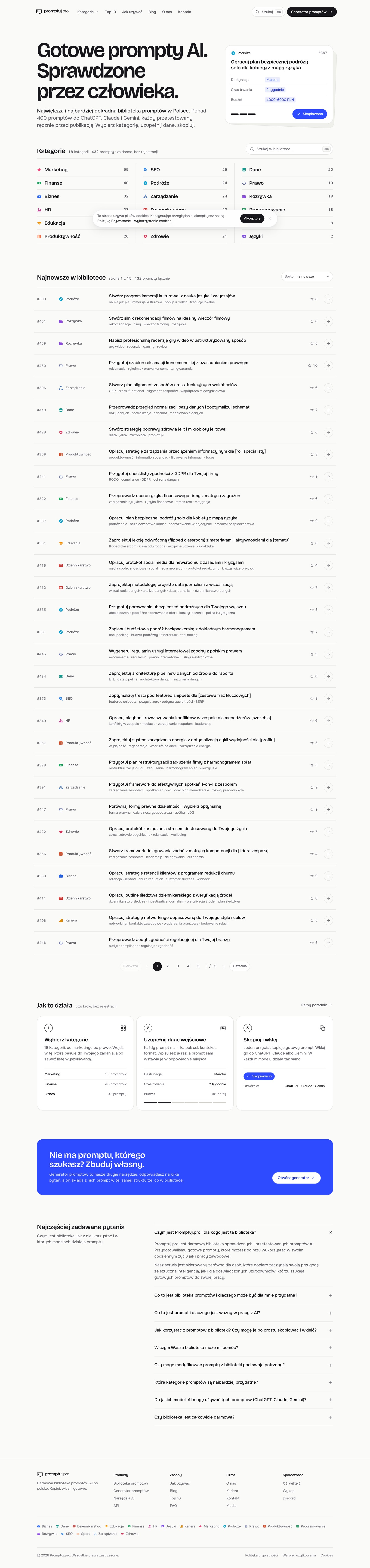
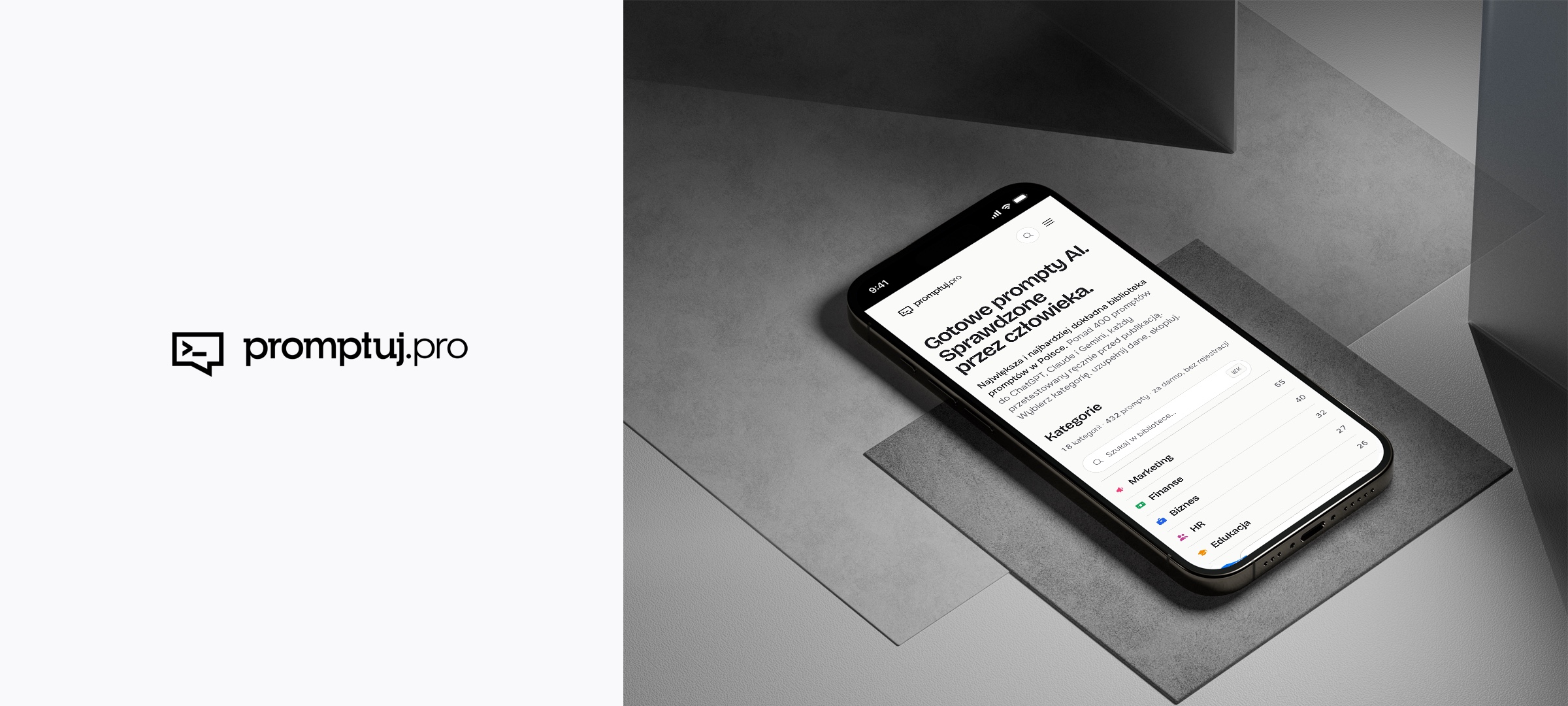
The homepage opens on the categories, eighteen of them with live counts, because the count is the proof that the library is real. Inside a category the prompts are a dense list rather than a grid of cards, so the eye covers thirty titles in one screen. Fill-in-the-blank fields are marked inline, so it is obvious what you have to supply before you copy anything. Search is one keystroke, ⌘K, for people who already know what they came for. Every prompt is reachable without a single click of consent theatre.
Editorial standard
The promise on the homepage is “checked by a human”, and that is the part that costs. Every prompt is written, run against the models it claims to support, edited and tagged before publication. A library that ships untested prompts is just a bigger blank field. The editing is the product, and the interface exists to get out of its way.
Identity
The logo is an original design: a terminal prompt sign set inside a speech bubble. It holds the two halves of the idea in one mark: the machine you are addressing, and the ordinary conversation you are having with it. It also survives being 24 pixels tall in a browser tab. Drawn in Illustrator, refined against the live interface rather than on an artboard.
The typographic voice is deliberately plain: one grotesque, heavy weights for headlines, generous line height, and near-black on warm off-white. Nothing about the styling signals “AI product”. The content is doing the work.
How it was built
The first passes were a designer’s: layout and flows in Figma, the mark in Illustrator. Once the direction was settled I moved the work into Claude Code and built the front end directly, with custom skills carrying my own design rules so that generated code came out in the house style instead of needing to be argued back into it. Kuba built the backend underneath it: the database, the search index and the publishing pipeline, so the library could grow past a few hundred prompts without the interface changing shape.
That split shifted where my time went. Far less of it on redrawing states that the browser can show me, far more on the two things that actually decide whether this product is any good: the structure of the library and the quality of each prompt in it.
Design
Build